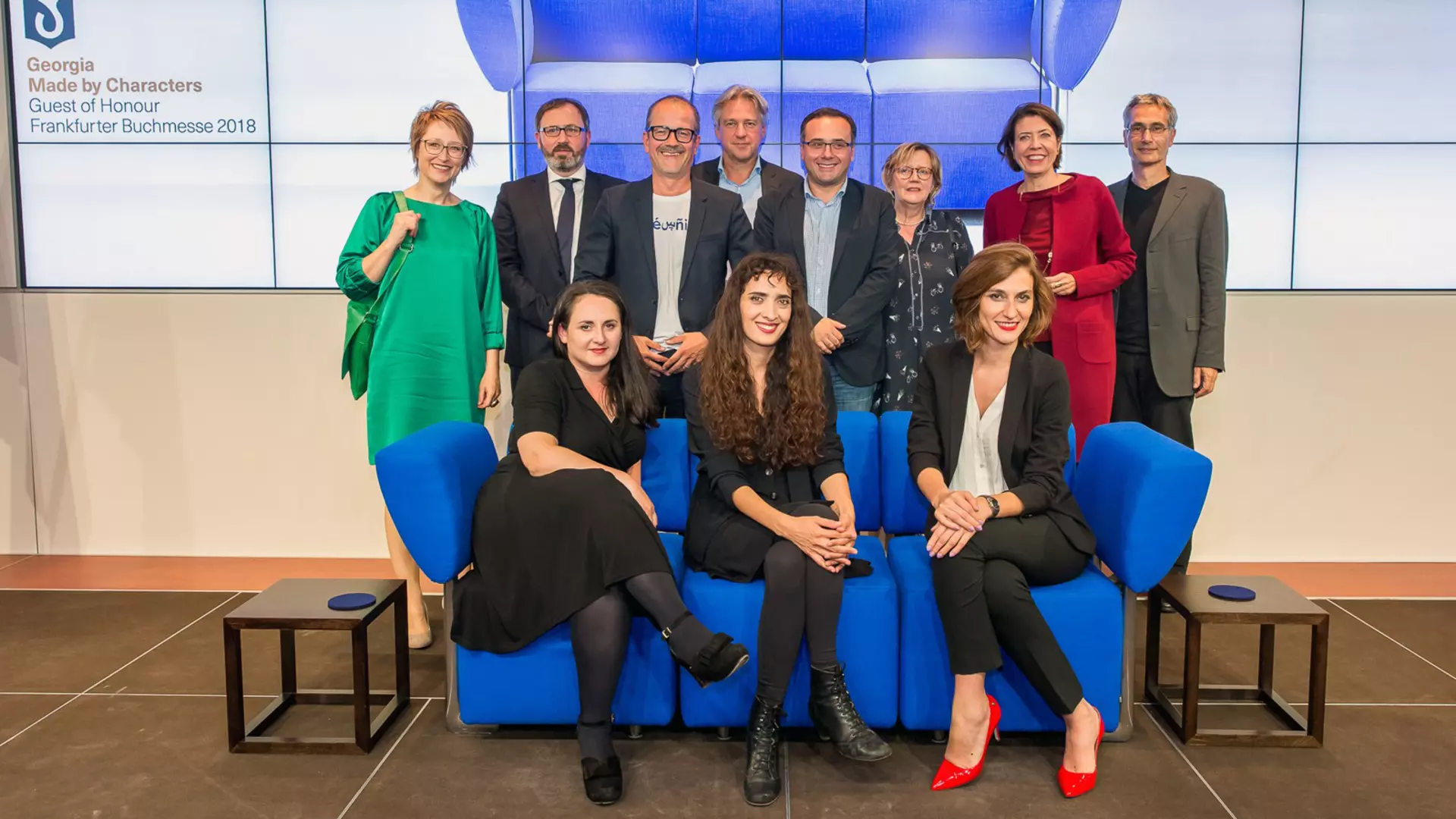
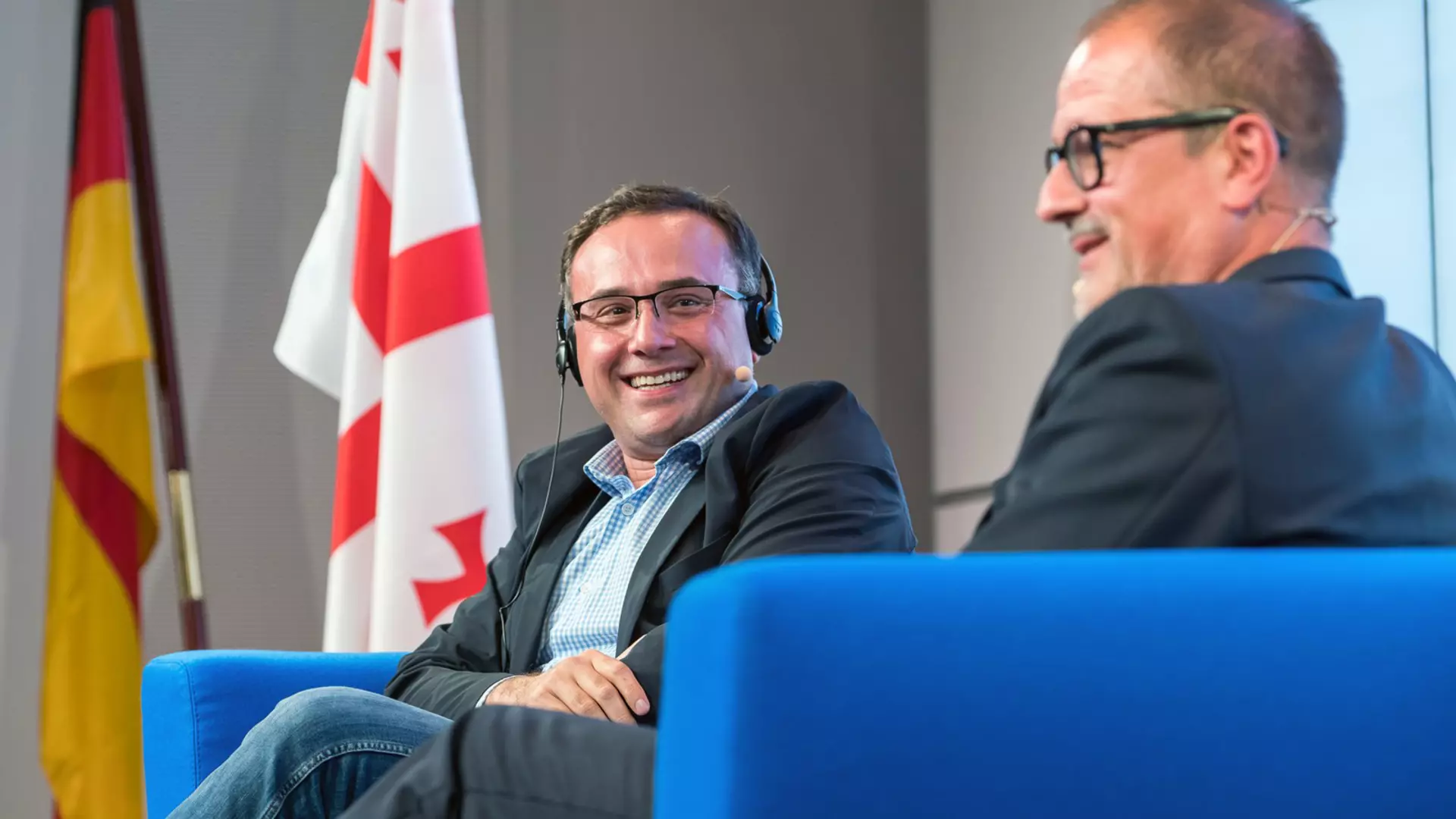
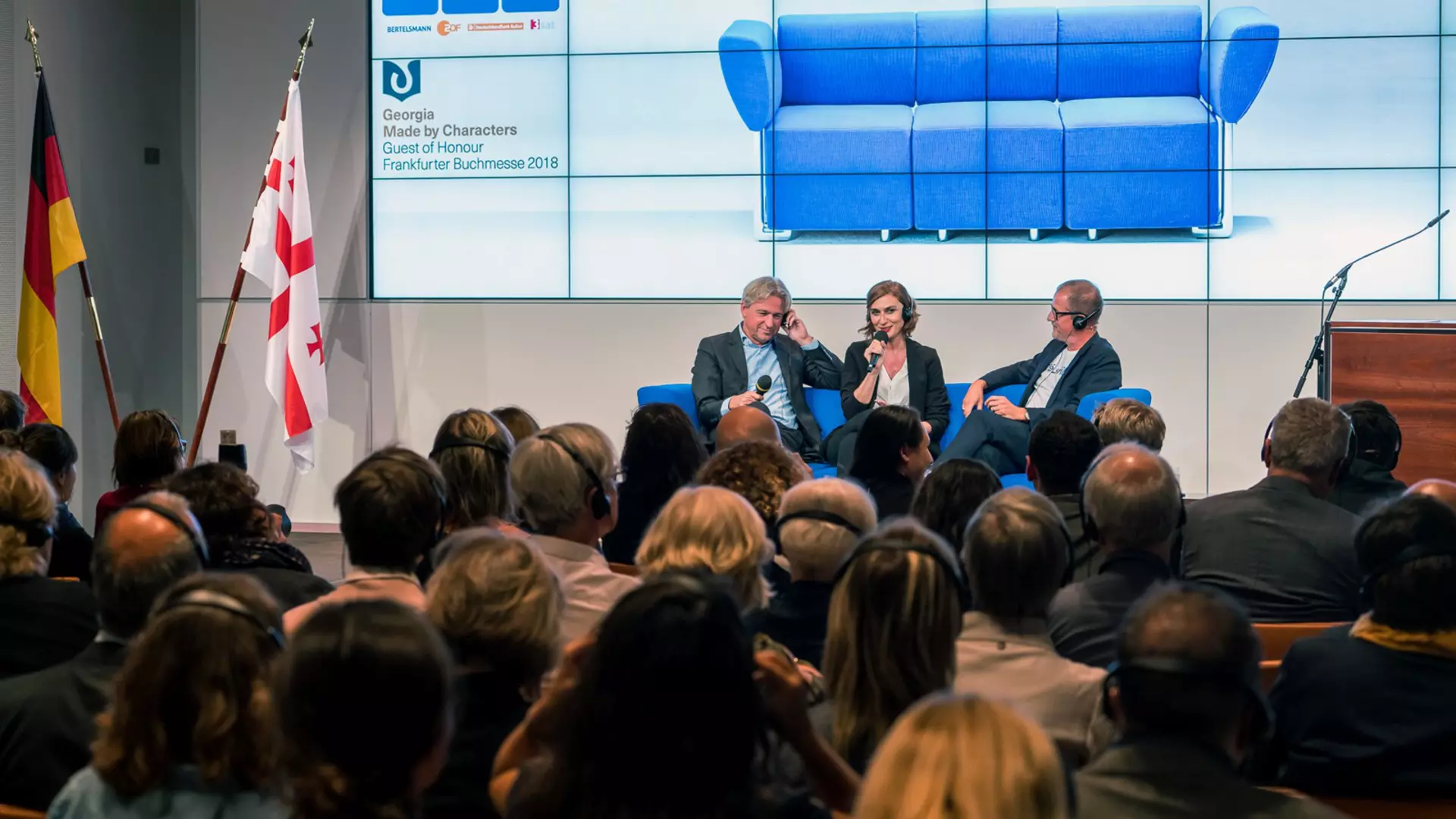

It has become a nice tradition: For the fourth time, the ‘Blue Sofa’, the joint author’s forum of Bertelsmann, ZDF, Deutschlandfunk Kultur, and 3sat, invited the guest of honor country of the upcoming Frankfurt Book Fair to Bertelsmann Unter den Linden 1 in Berlin. For most of the around 160 guests from culture, politics, and the media, Georgia probably is a “terra incognita”, as host Helen Müller, Director Cultural Affairs and Corporate History of Bertelsmann, said during her welcome address last Thursday – and she was looking forward to the evening even more because of this fact. “Bertelsmann has a diversified commitment to culture: with readings, exhibitions, concerts and film screenings,” said Müller.
The Ambassador of Georgia, Elguja Khokrishvili, classified the presentation as guest of honor country as political: Germany was the first country that recognized the Democratic Republic of Georgia after the declarations of independence in 1918 and 1992 and took up diplomatic relations. In the one hundredth year after the first independence, the relations with Germany are now celebrated with a variety of personal meetings.
Medea Metreveli, Director of the Georgian National Book Center and curator of the guest of honor country presentation, pointed out that Georgia regained its independence from the Soviet Union only 25 years ago: “Today’s authors are saying what the former Soviet generation did not want to say.” She promised to the German readers: “You will hear new voices, and you will perhaps listen to these voices.” Book Fair Director Jürgen Boos remembered that he already had first talks with the partners in Georgia six years ago: “First, I fell in love with the people of the country, then I read their books and got to know their culture, and that’s not the end yet.” With the guest of honor program, the book fair now wants, above all, to make the people behind the books visible.
Georgia will travel to Frankfurt with around 70 authors and with 160 books translated into German as luggage, Medea Metreveli added. The country will offer insights into its literature and other facets of the diversified cultural landscape.
“The Cat and the General”: Nino Haratischwili has prospects to win the German Book Prize
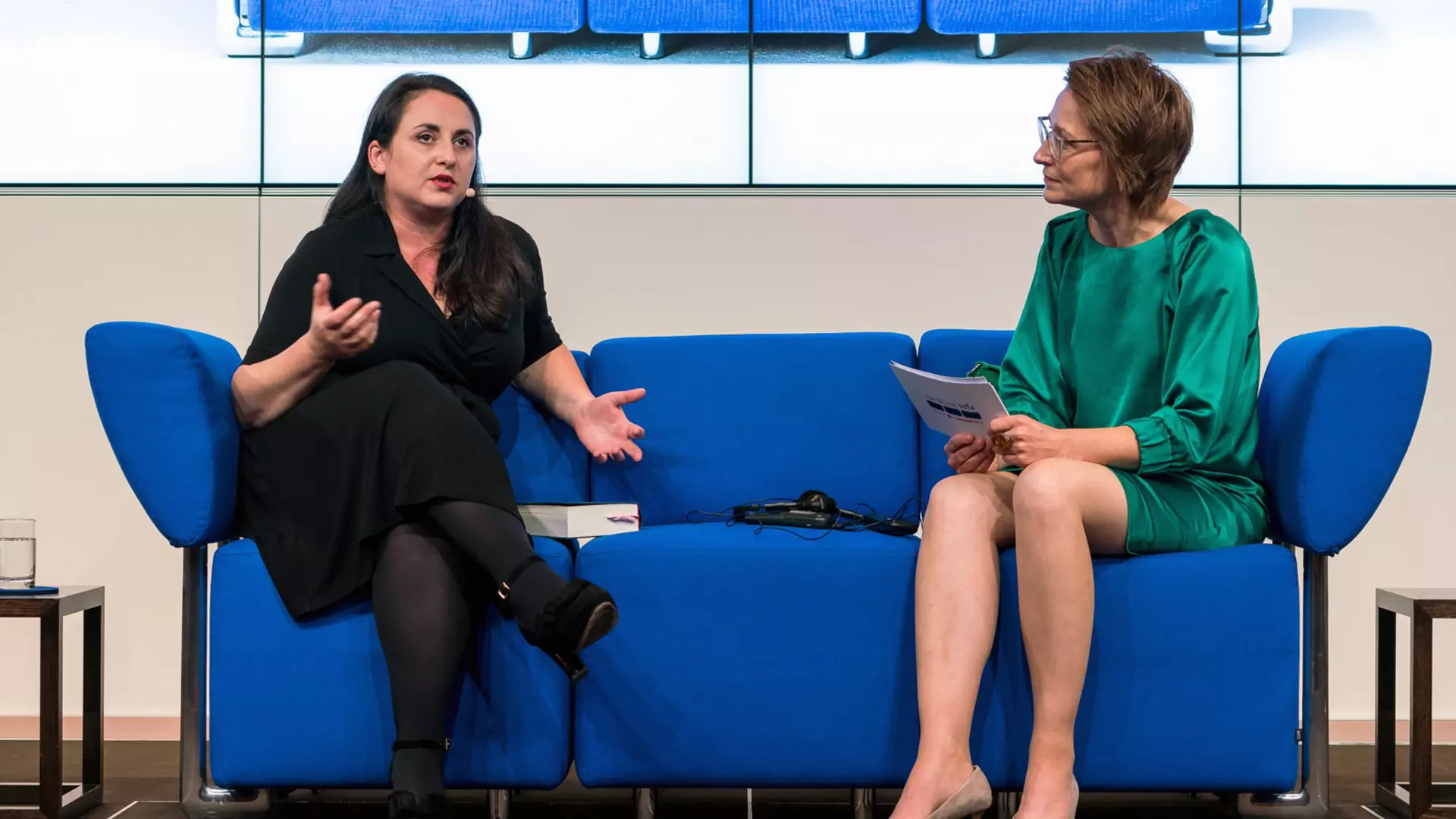
In Germany, Nino Haratischwili is the most famous female writer from Georgia. Born in Tiflis, she has been living in Hamburg for many years. She writes her novels and theater plays in German and has become one of the most important contemporary German language authors. Her current novel titled “Die Katze und der General” (“The Cat and the General”) is one of the six books shortlisted for the German Book Prize 2018.
On the Blue Sofa, she answered the questions posed by the host Eva Schmidt of 3sat. The initial impulse for this novel was the texts that were written by the Russian journalist and human rights activist Anna Politkowskaja, who was murdered in Moscow in 2006, about the atrocities of Russian troops in the first Chechen war. At the time, Politkowskaja wrote a reportage about a platoon of young soldiers that had been sent into a remote Chechen village for recovery after severe fights in Grozny in 2000. The soldiers charged into the village and kidnapped and tortured civilians. There were “thousands” of such cases; however, only this one precedent was dealt with in court. The author speculated that Russian President Vladimir Putin wanted to set an example. Haratischwili answered the question of how she experienced Chechnya during her research trip in 2017: “It is definitely one of the most surreal places I’ve ever been to.” All of the indications of the two Chechen wars were deleted from publicity, and nobody is to remember them. However, when she spoke with the people on site, the word “war” is included in every other sentence.
Host Daniel Fiedler, Director of ZDF-Kultur in Berlin, then welcomed the novelist Lasha Bugadze as a “colleague”, who also hosts a literary format on Georgian television. Bugadze’s novel “Der erste Russe” (“The First Russian”) is set in 1990s Georgia, when the economy of scarcity, corruption, and “old-boy networks” worried people. An author publishes a satire about the legendary Georgian Queen Tamar. Without ever having read the text, the patriarch of the orthodox church declares that the author desecrated the memory of Holy Tamar and, therefore, has to apologize to the church and the Georgian nation. “When I read this story in a Georgian chronicle, I realized that the relationship between Tamar and her first husband included all of the characteristic components of Georgian-Russian relations,” Bugadze explained, and he admonished: “In Georgia, we may have freedom of opinion today, but the state and church are still employing their powers unhindered to intimidate citizens and put pressure on them.”
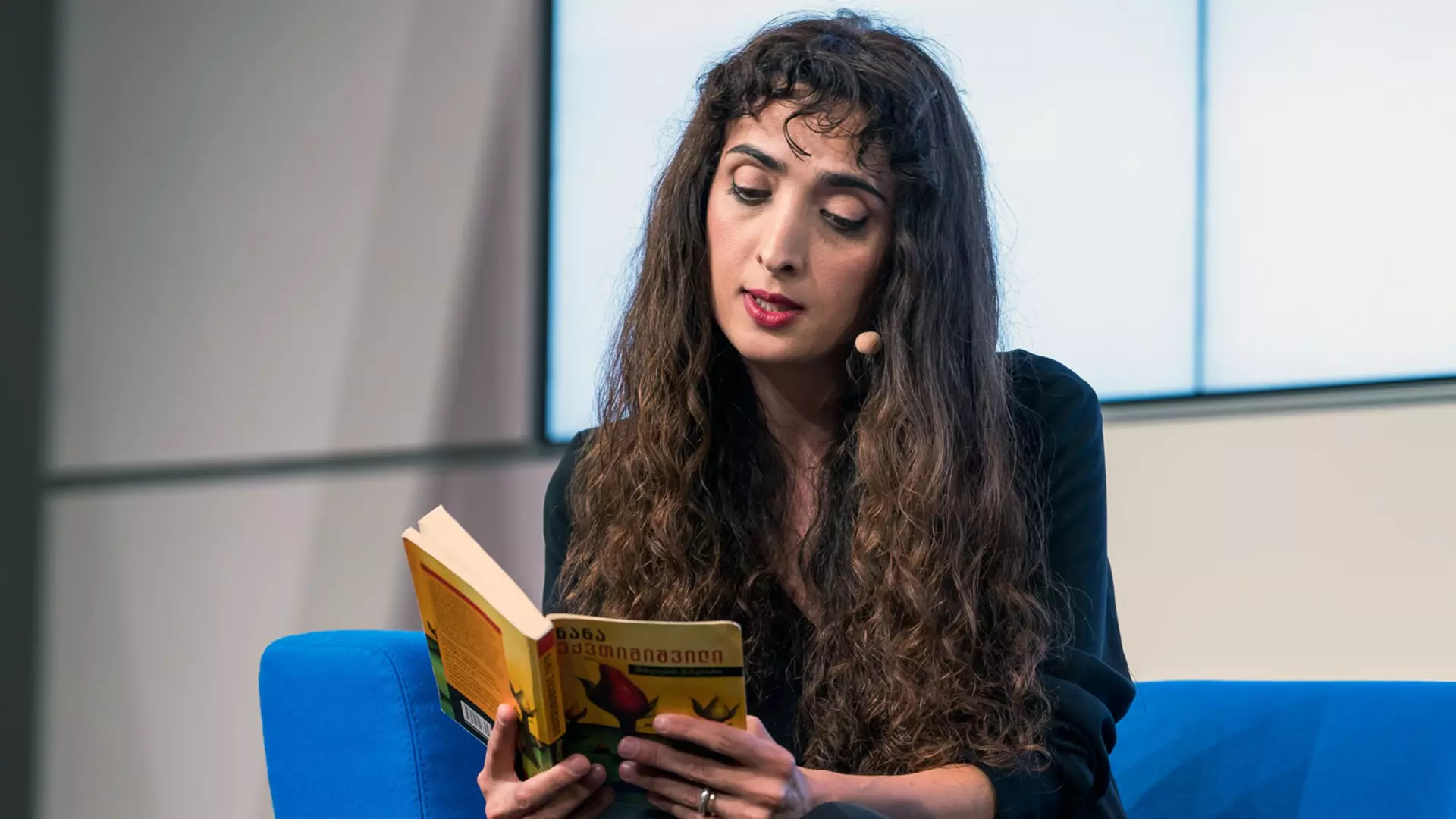
Host Jörg Plath of Deutschlandfunk Kultur introduced the third author as a woman with many talents: Writer and filmmaker Nana Ekvtimishvili once studied at the Babelsberg Film University. As a child, she lived in Tiflis next to many pear trees that belonged to a boarding school for children with mental impairments. Since the trees were permanently flooded by water due to a burst pipe, they always bore plenty of fruit; however, they were so inedible that even the hungry children did not eat them. The novel “Das Birnenfeld” (“The Pear Field”) is set in this boarding school – a relic from the Soviet era. For the author, the pears that nobody could use are symbolical for the children that nobody wanted. “The children were completely abandoned, and society and the neighbors were watching it.” Classes were not given. Nana Ekvtimishvilie answered the question of why young Georgian literature deals with the subjects of violence, abuse, war, drugs, and traumata so often: “That’s what our history was like; we experienced a lot of violence and wars.”
Despite the difficult subjects, the evening at Bertelsmann Unter den Linden 1 was one of understanding and approach. Over Georgian wine and typical food, the guests and authors had lively conversations. Many people grouped around the book table. Those who were unable to participate in the literary evening will be able to experience “Das Blaue Sofa Georgien” on September 30 from 12:05 a.m. on Deutschlandfunk Kultur as a compilation. The one-hour program will also be available in the Mediathek media library after the broadcast.