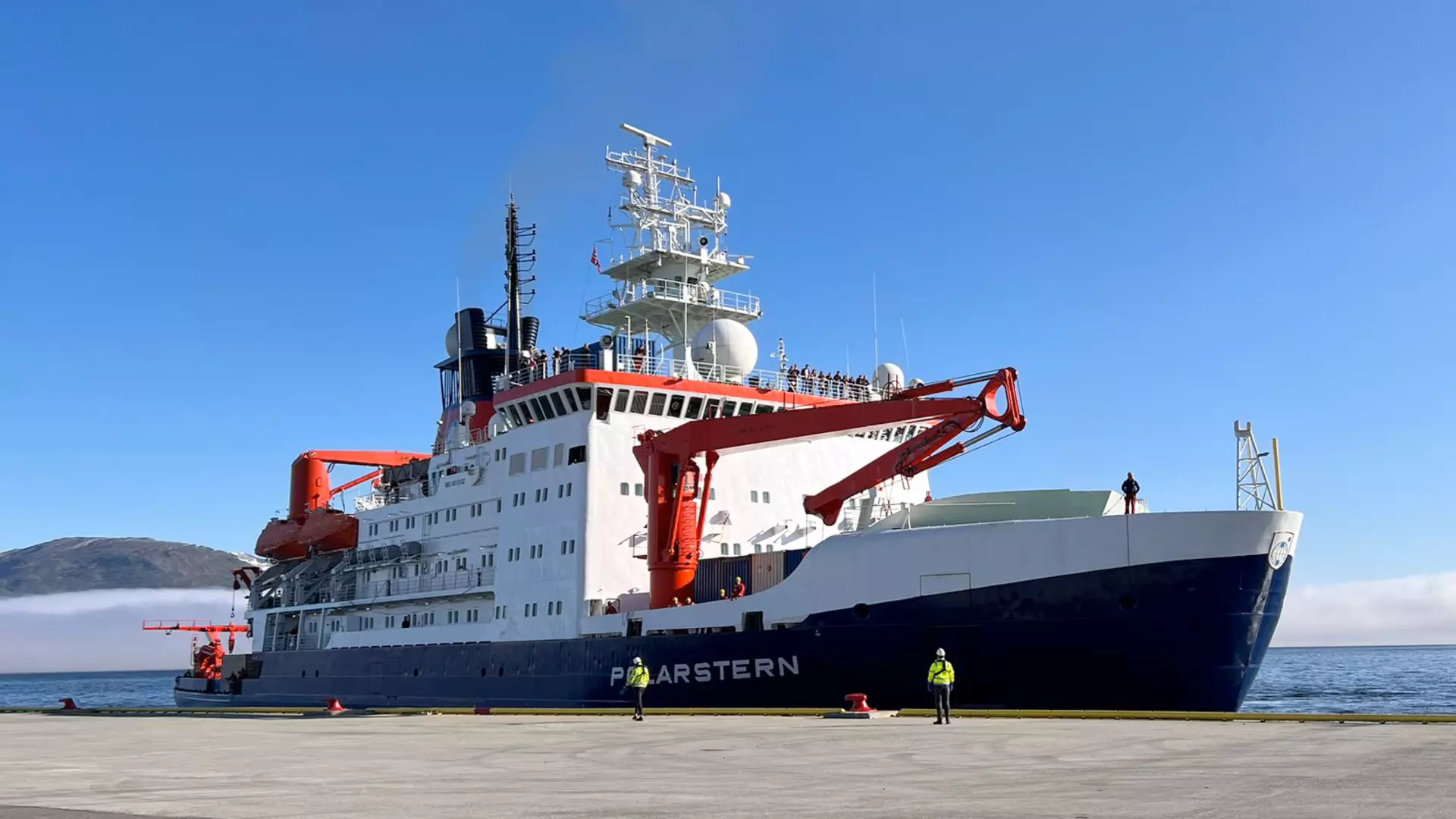
UFA Documentary will exclusively accompany the expedition “Arcwatch”, which started today, and produce the sequel to the award-winning UFA Show & Factual documentary “Artic Drift.” Viewers can expect unique images from a region of the earth that is as fascinating as it is endangered. The footage will be used to create the high-end documentary “Arcwatch – Hoffnung im Eis (Hope in the Ice),” which is scheduled to air on TV at Christmas.
“Arcwatch,” a new expedition organized by the Alfred Wegner Institute’s Helmholtz Centre for Polar and Marine Research (AWI), starts today from Tromsø, Norway. Four years after “MOSAiC”, the largest Arctic expedition in history, UFA will once again be on board the German icebreaker “Polarstern” as the expedition’s exclusive video producer. The two-month expedition to the Arctic will be accompanied by a camera team from UFA Documentary. The high-end documentary “Arcwatch – Hoffnung im Eis” is the follow-up to the award-winning UFA Show & Factual documentary “Expedition Arktis” (international title: “Arctic Drift”) and, as UFA reports, will be broadcast around Christmas as a movie by the German public broadcaster ARD, and as a series in the ARD Mediathek.
‘Impressive images on and under the ice’
“I still remember exactly how excited I was about the results and findings of the ‘MOSAiC’ expedition,” says Marc Lepetit, Producer and Managing Director UFA Documentary. “On the initiative of Nico Hofmann, a crew directed by Philipp Grieß was on board the research vessel ‘Polarstern’, where they produced ‘Arctic Drift’ for Ute Biernat’s UFA Show & Factual – an impressive and visually stunning documentary. It was a huge international success and our first collaboration with the AWI. Three years later, the first results of ‘MOSAiC’ have been evaluated and some of them will also find their way into ‘Arcwatch – Hope in the Ice’. It is a privilege for us as UFA Documentary to be able to spend exclusive time on the ‘Polarstern’ with Antje Boetius and her team and to produce another documentary, this one entitled ‘Arcwatch – Hoffnung im Eis’. Our team will do everything in its power to produce impressive images on and under the ice in order to show viewers what awaits us and where humanity’s journey might be heading.”
Philipp Grieß, director and producer of UFA Documentary, explains: “Being able to accompany the ‘Arcwatch’ expedition led by Antje Boetius is exciting for many reasons: What the scientists on the German research icebreaker ‘Polarstern’ are doing in the Arctic is unique worldwide. We will be up close to see how this groundbreaking research is created, what life forms are hidden in the deep sea under the sea ice, and we will see what specific insights we can derive from it for our political actions. All this would not be possible without the crew of the ‘Polarstern’. We will once again be able to experience the daily work of one of the most experienced ship crews in the polar regions. They find a solution for every challenge the ice presents them with. It is hard to say what we will discover on this journey, because every expedition into the ice is a journey into the unknown. That we as UFA Documentary are permitted to be part of this team is a great honor and privilege for us.”
One of the hotspots of climate change
Prof. Dr. Antje Boetius, expedition leader and director of the Alfred Wegener Institute, adds: “My 50th international deep-sea expedition is about returning to places in the Arctic Ocean that have become a kind of second home. Since my first expedition into the ice 30 years ago, I’ve wanted to know how life works in an ice-covered ocean, all the way down to the deep sea. The Arctic is one of the hotspots of climate change, and shrinking sea ice is rapidly changing this unique habitat. We want to document whether and how Arctic ocean life is adapting. In times of increasing threats to marine life, we want to put faces and names to Arctic algae, animals and microbes. I am very pleased that UFA will be present with its camera team and will cover this rapid change, whose ramifications extend into the deep sea. This way, a broad audience can participate in the research in this unique region and accompany us in our discoveries.”
The documentary will show material from the “Arcwatch” expedition as well as previously unpublished image and video material and new research findings from the “MOSAiC” expedition. “MOSAiC” had mainly investigated the physical framework of the climate system in the rapidly changing “New Arctic”. But what do these radical changes mean for the biological network of life in the Arctic – and can the Arctic ice still be saved? Antje Boetius, Germany’s best-known marine biologist and director of the Alfred Wegener Institute, sets out to find answers in a separate expedition. She will be accompanied by Esther Horvath, one of the best polar and science photographers and “MOSAiC” veteran, making her a participant in both expeditions. Her special focus is on inspiring researchers, whom she portrays as role models.
Follow the expedition in the Polarstern app
“Arcwatch – Hoffnung im Eis” is a UFA Documentary production commissioned by ARD. The producers of the high-end documentary are Marc Lepetit and Philipp Grieß, who is also the director. Nico Hofmann and Ute Biernat are responsible for the material of the production around the “MOSAiC” expedition. Norddeutscher Rundfunk (NDR) is in charge of the project within ARD. The “Arcwatch” expedition is the follow-up to 2012’s “Icearc” expedition. The “Arcwatch” research team wants to find out how the rapid warming of the Arctic and the dwindling of sea ice are affecting the entire ocean system from the surface to the deep sea and how the biological network of life is adapting to the “New Arctic.” This involves analyzing the biology, chemistry and physics of sea ice using a range of proven and new technologies. Marine biologist Antje Boetius already conducted research on this eleven years ago on the “Icearc” expedition, and will now record the status quo once again. As in 2012, the investigations will take place in the ice edge zone and in the central Arctic. In addition, the expedition will revisit stations of the “MOSAiC” expedition. More than 50 international scientific participants are on board the “Arcwatch” expedition, representing 24 institutions from eight nations. The “Polarstern” is scheduled to return to its home port of Bremerhaven on October 1. While the expedition is still underway, impressions from on board the “Polarstern” will be provided on Radio Bremen’s radio program, and interested parties can also follow the expedition in the Polarstern page.