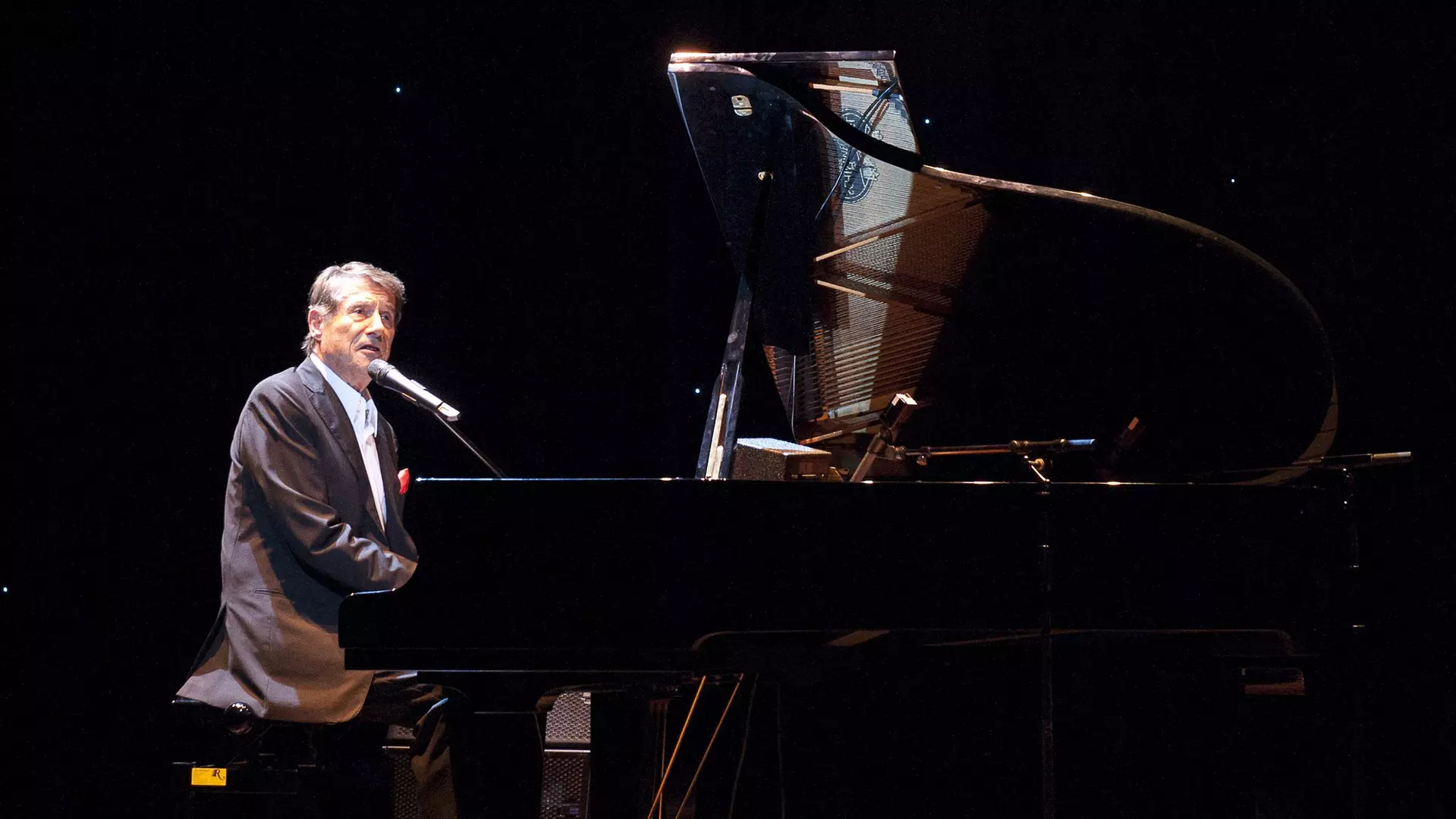
Bertelsmann mourns Udo Jürgens, who died yesterday at the age of 80 – but yet still appeared to be, as the title of his latest album put it “In the Prime of Life.” Over decades, he indisputably made music history in and for the German-speaking countries like none other. Today’s countless obituaries and eulogies provide impressive proof. But Udo Jürgens made music history particularly for and at Bertelsmann. Ariola and former BMG attended nearly his entire career. He was a close friend of the company and always a welcome guest, most recently at Bertelsmann’s 175th anniversary in Berlin in 2010 – on which occasion he was filmed as saying: "I have been privileged to experience an incredible time with Bertelsmann. Bertelsmann is basically my curriculum vitae. "
According to his management, the singer/composer collapsed yesterday afternoon on a walk in his homeland Switzerland and died of heart failure shortly afterwards at the Münsterlingen hospital. Just a few months ago, the music world had celebrated Udo Jürgens’ 80th birthday. Jürgens was born in Klagenfurt, Austria, on September 30, 1934. In interviews and reports, he was present and strong as ever, giving his all on stage until the end – including during his last tour, which came to an abrupt end yesterday.
n 1947, Udo Jürgens began his musical studies – in harmony, composition, voice and piano – at the Carinthian State Conservatorium in Klagenfurt. He first become known to a wider audience in the 1960s, and in 1964 competed for Austria in the Grand Prix Eurovision Song Contest in Copenhagen. Two years later, the third time he competed, he took first place with “Merci Chérie” on March 5, 1966 in Luxembourg, and achieved his international breakthrough.
Bertelsmann and Udo Jürgens had a long and close partnership. When in 2008, Ariola – at the time a BMG subsidiary – looked back on 40 years of cooperation with him, the artist had himself declared in a personal greeting: "In our impermanent profession, a collaboration that extends over so many decades is entirely unusual. This long partnership has given me freedom in my artistic work that would otherwise have been inconceivable. I probably used it correctly, and therefore perhaps it was precisely these freedoms that made my late career such a special success. I have had close ties with Bertelsmann the whole time, since the early days of its music business to its development into a global corporation. "
The partnership was expressed in the friendship that united Udo Jürgens and the Mohn family, but also in memorable events such as an exclusive concert he gave in Bielefeld before 1,500 Bertelsmann employees in 1968 – but above all in Jürgens’ inexhaustible artistic-creative output. He published more than 1,000 songs, produced over 50 albums and sold more than 100 million albums, making him one of the most important and successful artists ever for Ariola. And given the length of the cooperation, it is hardly surprising that his autobiography, “Der Mann mit dem Fagott” was published by the Random House imprint Limes in 2004.
Awards including a Silver Lion, four Bambis, five Golden Europas and the Echo accompanied his work. According to “Spiegel Online” his “Udo 70” tour of the German Federal Republic, Austria, Switzerland and then Eastern Bloc countries in the 1970s broke European records. He gave 222 concerts in front of half a million people. Udo Jürgens' most famous songs across the generations include “Was ich dir sagen will,” “Griechischer Wein,” “Ein ehrenwertes Haus” and “Aber bitte mit Sahne,” but above all of course “Merci Chérie.” Now it is Bertelsmann’s turn to say “merci”… and adieu.